House Object Equipment Icon Set
A Designer’s First Look: Clean, Quiet, and Surprisingly Versatile
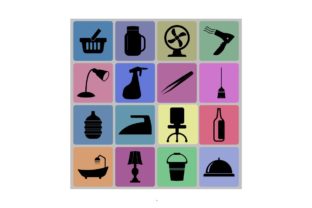
Opening the House Object Equipment Icon Set, I immediately felt its quiet confidence—not flashy, not fussy, but thoughtfully grounded in everyday domestic life. These seven icons—Basket, Cup, Fan, Hairdryer, Study Lamp, Sprayer, and Tweezer—aren’t stylized or cartoonish; they’re simplified with gentle curves, balanced negative space, and consistent stroke weight. As an embroidery designer who’s stitched everything from nursery wall art to boutique aprons, I appreciated how each icon avoids visual clutter while retaining clear recognition at small scales. It’s the kind of set that whispers “handmade care” rather than shouting “trendy graphic.” That tone matters—especially when you’re stitching a personalized baby towel or embroidering a linen tea towel for a wedding gift.
How It Stitches: Real-World Performance on Common Projects
I tested the House Object Equipment Icon Set across three real projects: a cotton canvas tote bag (for a local herbalist shop), a lightweight organic cotton baby onesie, and a twill-lined embroidered patch for a craft fair vendor badge. On the tote, the Study Lamp and Basket icons held up beautifully with satin stitch borders and clean fill stitch interiors—no thread nesting, no puckering, even without heavy stabilizer. The Cup and Fan icons translated especially well to sweatshirt embroidery: their open shapes allowed breathability in dense knit fabric, and the clean lines prevented “mushiness” after washing.
For baby embroidery, the Tweezer and Sprayer icons surprised me—they read clearly at 1.8" tall, with no fragile details lost in the stitching. That’s rare in icon-based machine embroidery designs. On textured fabrics like terry cloth towels, I used a light tear-away + cut-away combo stabilizer and kept stitch density moderate; all icons retained shape and legibility. Even on curved surfaces like caps, the Fan and Hairdryer icons adapted smoothly when digitized with slight contour compensation—no distortion or stretching.
Where It Shines—and Where to Pause
The House Object Equipment Icon Set feels tailor-made for thoughtful, small-batch work: embroidered pillow covers for a cozy home goods line, minimalist aprons for baking studios, holiday gift tags with a tiny Cup or Sprayer, or nursery decor where softness and clarity matter more than boldness. It’s equally strong as design assets for printable mockups—these icons scale cleanly from 1" patches to 4" applique designs without losing integrity.
That said, I’d avoid pushing it into ultra-fine detail work. There’s no tiny lettering or micro-line work here, and that’s intentional—and wise. If you’re planning a high-density decorative accent on stretchy jersey or thin rayon, test the Hairdryer or Study Lamp first: their longer forms can pull slightly on unstable fabrics without proper hooping and stabilizer pairing. Likewise, on dark fabric, ensure your thread colors offer enough contrast—the icons rely on silhouette and proportion, not texture or shading, so low-contrast thread choices will mute their impact.
What It Adds to Your Finished Product
This isn’t just a collection of graphics—it’s a subtle brand amplifier. When I stitched the Basket icon onto a handmade linen market bag for an Etsy seller, customers commented not just on the craftsmanship, but on how “intentional” and “calm” the design felt. That’s the power of cohesive, human-scaled iconography: it builds trust, signals attention to detail, and elevates a simple embroidered patch into a signature touch. For craft business owners, that translates directly to perceived value—especially on personalized gifts or boutique merchandise where emotional resonance matters as much as execution.
It also supports consistency across product lines. Pair the Cup with a custom coffee blend label, the Fan with summer-themed kitchen towels, the Tweezer with a beauty kit gift set—and suddenly you’ve got a unified visual language, not just isolated decorations. That cohesion strengthens buyer engagement and makes digital embroidery files feel like part of a larger story, not disposable clipart.
Practical Notes Every Embroidery Designer Should Check
- Always test on scrap fabric first—especially with textured or stretchy materials. The icons are clean, but fabric behavior is unpredictable.
- Review stitch density before scaling up. These icons were designed for clarity, not heavy coverage—over-digitizing can flatten their charm.
- Confirm hoop size compatibility. While the icons are scalable, very small versions (<1.2") may need simplified stitch paths—check if your embroidery software handles that smoothly.
- Inspect corners and curves—particularly on the Hairdryer handle and Sprayer nozzle. These areas should hold shape without skipped stitches or thread breaks.
- Test black-and-white mockups before finalizing thread colors. Since these are silhouette-driven icons, grayscale previews reveal contrast issues faster than color screens.
- Use appropriate stabilizer: medium-weight cut-away for knits, light tear-away for stable wovens, and fused + tear-away for layered garments like reversible aprons.
- Verify licensing terms before selling finished products or digital embroidery files—this set is editable and usable across graphic software, but commercial embroidery rights depend on the original license.
Final Thought: A Quiet Workhorse, Not a Flashy Gimmick
The House Object Equipment Icon Set won’t dominate your portfolio—but it’ll earn repeat use. It’s the kind of embroidery file you reach for when you want reliability, warmth, and quiet professionalism. Whether you’re prepping a custom embroidered tote bag for a client, designing a cohesive line of handmade kitchen textiles, or building digital product previews for your Etsy shop, this set delivers clarity without compromise. It respects the craft, honors the fabric, and quietly reminds your customers that good design lives in the details—even the ones you use every day.